I. I like tech and I like data. Well, I like understanding things.
I’m someone who feels more secure when the world can be measured or charted or at least represented in a model. If I can convert something into data, I can grasp it. And if I understand it I can play with it.
Whether in research or my personal projects, I’ve always had this reflex: analyze → model → play with it.
So, of course, trading had no chance – It was inevitable that I would fall into it.
II. Trading is data! A lot of data and a universe to explore.
Some people see trading as a modern casino. I saw it, and still see it, as a complex, fractal-like, multi-scale system that merges pseudo-organization and chaos in the same candle.
I started with the macro picture: trends, cycles, volume, and market structure. Then I zoomed in, again and again, until I found myself reading the micro-behaviors: breaks of structure, liquidity traps, Fair Value Gaps, tiny imbalances that last a few seconds and disappear forever.
At some point, it all felt strangely coherent. Like watching the weather of a trading ecosystem; thermal currents, turbulence, or invisible shifts in pressure.
And I thought: “Okay. This is just another system. I can read this. Yhouhou”
(Yes of course ;p – Well – No ! Not quite)
III. First reality check: I needed a tool !
The more I explored, the more I realized that the existing trading platforms were good… but not how I wanted them to be. Too much clutter, too many limits, not enough control. Not so clear in the way they are working probably not on purpose but not as my brain is designed to work.
What I wanted was something clean and minimalistic. So I did what any rational engineer does when confronted with a lack of tools: I built my own.
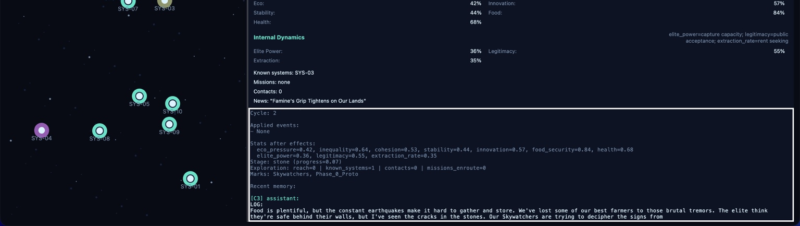
A Raspberry Pi trading webhook server, secure tunnels, a local dashboard, OKX integration, one-time tokens, logging, and latency tracking – the whole thing escalated into a mini-startup infrastructure before I even placed a real trade.
It’s funny how you can end up designing a complete pipeline to send a $15 order with “peace of mind”. Yeah, but it was hiding something.
IV. Everything was ready… except me.
And this is where the story tilts.
- The server worked.
- The strategy framework worked.
- The signals from TradingView were clean, and promptly pushed to my little too cute server.
- The risk management was defined.
But my brain absolutely wasn’t ready.
I would enter too early. Exit too late. Hesitate at the worst moment. Imagine threats where there were none. Feel FOMO, disbelief, hope, disappointment, all compressed into 30 seconds.
At some point, it became clear: The issue wasn’t technical. The issue is psychological. The issue IS in my brain!
Trading is a mirror. It shows you exactly who you are, without filters, and sometimes you don’t like what you see.
V. The unexpected link: “Come on, just take off.”
This is where paragliding sneaked into the story. In paragliding, takeoff is one of the most delicate moments. If you hesitate — really hesitate — and you will, you mess it up.
If you run too early, you botch the takeoff. If you run too late, you lose the window, and those fu*** clouds are back, or the wind is too strong.
The air doesn’t care about your intentions. It doesn’t wait for you to feel ready or tell you, “Hey Denis, that’s the right time to go, it will be perfect for the next few hours or so”. The market is a bit the same. You can study, analyze, model, prepare the perfect setup… and still freeze at the moment you should simply start.
Paragliding taught me something brutally simple: Your mental state decides everything.
VI. A longer adventure than planned
I thought this journey would take a few weeks. It’s taking months, maybe years. And that’s fine.
I’m learning to read the market the way I try to read the sky: not as an enemy, not as a prediction machine, but as a complex environment you navigate with respect.
I’m learning to observe my own mental habits to notice my hesitation; to understand my over/under-confidence. To slow down when necessary. And to “take off” when the moment I feel it right.
Suppose I ever truly manage to “fly” in trading. In that case, I hope I’ll look at the market the same way I will look at a thermal: with curiosity, humility, and the awareness that the most “tricky” thing… is usually myself.
Photo by Milica Spasojevic